

A few weeks ago, everything changed in a small but powerful way. I was exploring the capabilities of the new o3 model from ChatGPT when I had an idea.
Phillip, my autistic son, stood in front of me looking confused, as usual. He’s in his mid-twenties, understands the world around him well, but he’s barely verbal. He can name objects, but putting together even a simple sentence just isn’t something he can do. He can’t really read either, and so communicating with him is always a bit of a challenge. At home we’ve learned to cope through routine and a lot of love. Still, we always wish we knew better what Phillip wanted.
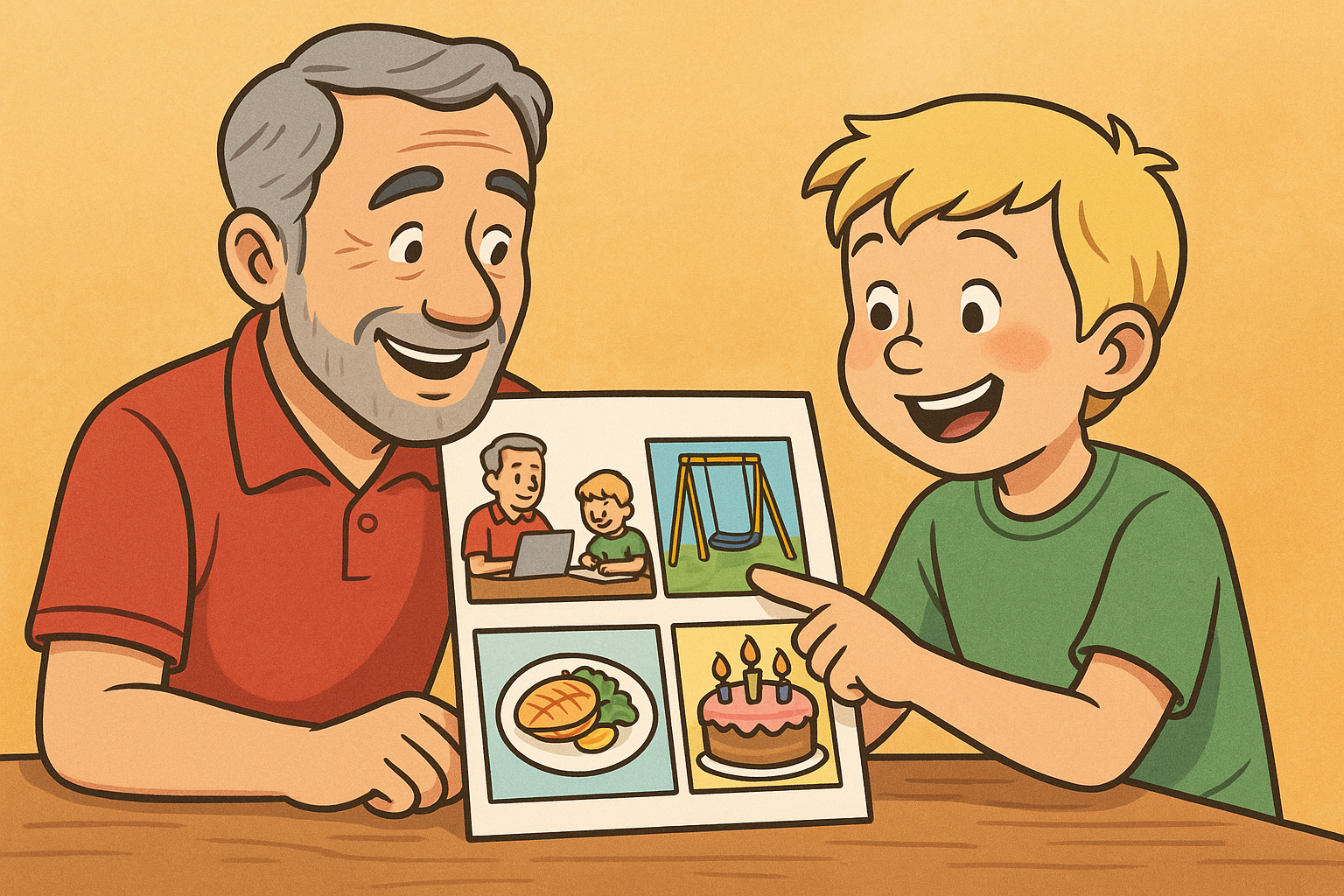
At that moment, I opened ChatGPT and asked it to create a cartoon image showing a few different activities he could choose from. When I showed the picture to Phillip, he immediately pointed—decisively and happily—to the one with a swing. And just like that, we had a plan.
It was a breakthrough.
From PECS to AI
For years, we’ve used PECS (Picture Exchange Communication System). It’s a great system, and many schools for autistic kids rely on it. But we don’t use PECS that often at home. It takes a lot of work to find the right pictures quickly, and the choices are usually pretty generic. You might have a card for “pizza,” but not for “pepperoni and grapefruit pizza,” if that’s what your kid is actually craving.
With ChatGPT-4o and o3, that limitation disappeared. Now I can generate PECS-style visuals instantly, in about a minute. I just type in a description, and it gives me a custom cartoon-style image that’s exactly what we need. You can also ask for realistic drawings, but for Phillip, cartoon style seems to work best.
It has made a huge difference in helping him make decisions. Spoken questions don’t always connect for him. Pictures do.
Helping Phillip Choose
Here’s a real example of a prompt I used:
Give me a cartoon style picture that has four parts. Dad is a grey-haired man in a red polo shirt with tan pants, Phillip is a blond-haired boy in a green shirt and blue jeans. Both are Caucasian. In picture #1, Dad and Phillip stay home. Dad on the computer, Phillip drawing on paper with crayons. Picture #2: Phillip on the swings. Picture #3: Dad and Phillip on a paved path in the woods. Picture #4: Dad and Phillip sit outside on rocking chairs on the porch.

Phillip pointed to the swing without hesitation. No guesswork. No stress. Just a clear answer. Other days he points to the walk or sitting outside. It’s wonderful to know what his preference is.
Choosing What to Eat
Meals are another challenge where ChatGPT has helped.
Here’s the kind of prompt I use:
We are going to eat out today. Take this menu, https://www.sparkyslanding.com/menu
, and draw me the major items in a PECS style for my autistic son to choose from. Make sure to have at least one salad, one fish, and one from each major category.

He happily chose the Wedge Salad (I was brave enough to try the Shrimp and Bacon Pizza. It was really much better than it sounds!)
You can go even further:
Give me 8 cartoon pictures of ice cream cones—4 chocolate and 4 vanilla. One of each should be plain, but for the others add gummy bears, sprinkles, peanut butter cups, pretzels, chocolate jimmies, and fudge sauce.

Most days Phillip goes for plain vanilla, but occasionally he finds the sprinkles irresistible.
You can even ask ChatGPT to put labels under each drawing, if that helps.

Phillip usually chooses the hikes, but on cloudy days sometimes prefers to walk.
Talking About Feelings
One thing that surprised me was how well it worked for emotions too.
I asked ChatGPT to create a four-panel cartoon showing Phillip feeling happy, sad, angry, and surprised. I showed it to him, and he immediately pointed to “happy.”

Phillip is a happy person, so that’s no surprise, but very nice for him to be specific about it. Sometimes I mix the order of the images, to make sure he isn’t just picking the first one, and he doesn’t. He picks the one he truly wants.
Planning the Day
It’s also great for creating visual schedules. For Phillip’s upcoming birthday, I had ChatGPT make a large cartoon image that shows the full plan: waking up and brushing teeth, going to a café for breakfast, rock climbing, lunch at a restaurant, visiting an amazing flower garden, and finally having cake in the evening.

Seeing the whole day laid out in pictures helps Phillip prepare for what’s coming, and it makes big days feel a lot more manageable. These schedules are nothing new, his school used them for years, but being able to generate one customized to him in seconds is a big step forward.
A Whole New Way to Communicate
Each picture takes about a minute to create. They’re not always perfect, and sometimes I’ll tweak the prompt and try again. But having quick, specific, personalized images ready whenever I need them is a complete game changer.
Once you learn how to write simple prompts, you can use this tool in endless ways.
For me, this has completely changed the way I communicate with Phillip. It has given him a voice he never had before, and more importantly, it has given him the power to make his own choices.
Of all the things I’ve seen AI do, nothing has felt more meaningful than this.
If you are interested in other innovative uses of AI you might try Mirror Mirror, my AI Powered Beauty App.


Leave a Reply