Stepping into the Unknown: Traveling the Path
A few weeks ago, I participated in my first 5-mile race. I had never run a race longer than a 5K before. I knew it would be challenging, but I hadn’t expected how enlightening the experience would be or how much it would help me reflect on life and how best to live it. It showed me that running the race to the best of one’s abilities and enjoying yourself on the way are far more important than what place you come in.
Initially, I wasn’t planning to run this race. I was extremely intimidated; in fact, I wasn’t even sure I had ever run 5 miles nonstop before. I found myself running simply because I had mentioned to my trainer that the race was happening near where I’d be staying, intending to add, “but I don’t think I’ll race.” Before I could get the words out, he said, “That’ll be perfect practice for your 5K training.” At this point, I felt committed. Like I’d be embarrassed if I didn’t run.
Wrestling with Shadows
I thought about this a lot and mused over why I was hesitant to run. After some meditation, I realized I was afraid I might embarrass myself. My time might be terrible, and I might be seen as a poor runner. Of course, only my trainer even knew I was considering running, so if I did poorly, no one else had to know. Still, this was my worry.
A bit more introspection revealed it had to do with my identity. I had come to see myself as a moderately good runner. Not being able to finish a 5-miler, or finishing it by walking, would be strong evidence against that identity. Objectively, this made no sense. After all, just two years earlier, I would get out of breath when walking a brisk half-mile, so by any reasonable standard I was doing great. This was simply a mental roadblock trying to protect my self-image.
The morning of the race was beautiful—cool and sunny. So I decided to go out and race to see what happened.
Among Fellow Pilgrims
There were about 700 people running the race, so it was quite crowded. I started somewhere near the top third of the crowd. My goal was simply to finish the race without walking. I could jog as slowly as I needed to, but no walking.
I began to wonder why others were there. In talking with people, most were there because they’d been encouraged by friends or family. Many were running to raise money for various charities. Some of the more serious runners were aiming to win the prize money or achieve a personal best.
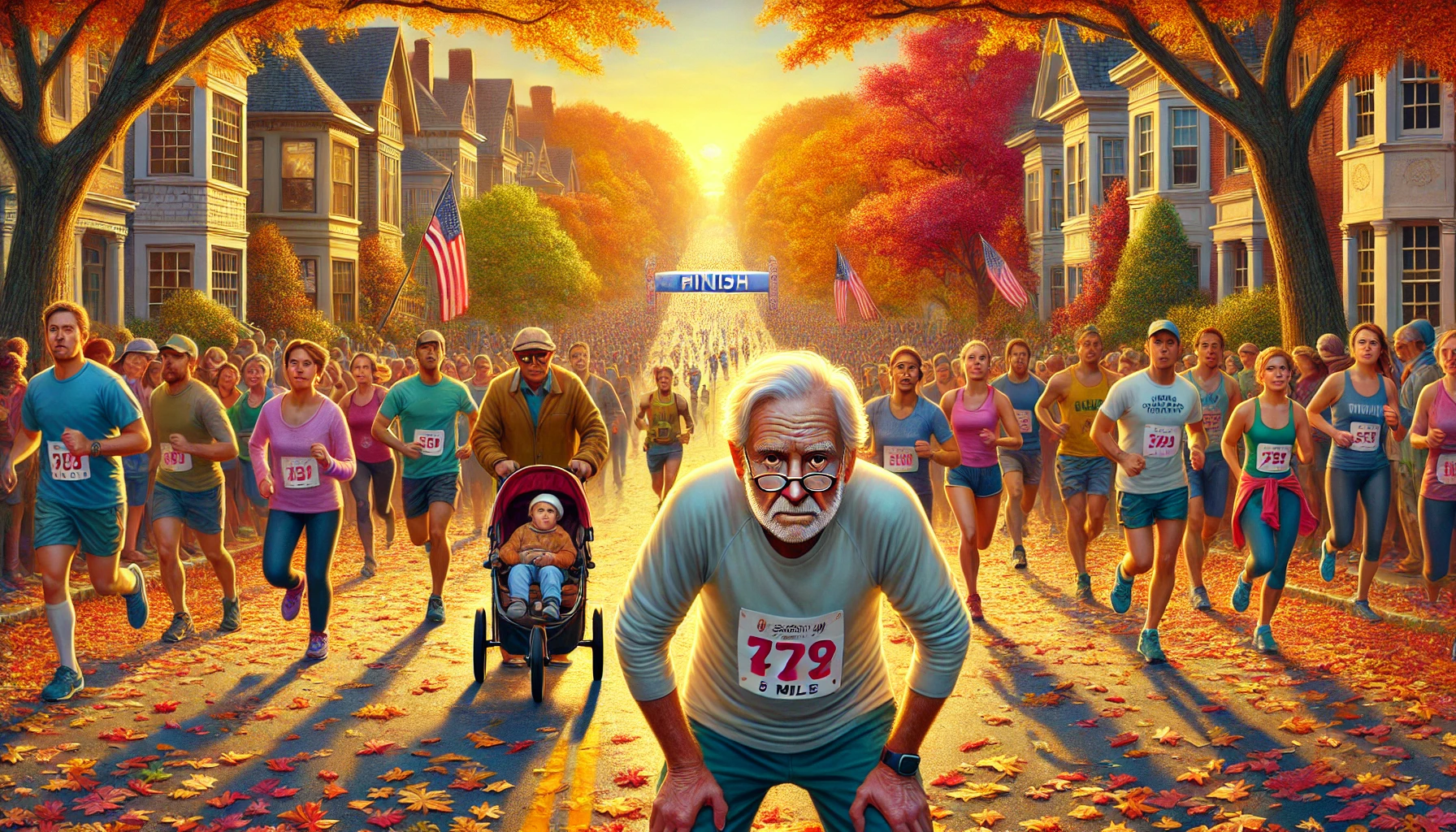
One woman said she was there because she wanted to see the area while running. We were traversing lovely streets in an affluent suburb, with beautiful autumn foliage and stately mansions on each side. These streets were closed off to cars for the run, and without sidewalks, they weren’t places you’d want to run when traffic was around.
Pacing Myself
Before the race, I had set my sports watch to pace myself at 12:00-minute miles so I would finish in one hour. For reference, the winners usually average about 6:00-minute miles, my 5K pace is closer to 9:00, and a brisk walk might be 15:00-minute miles. So 12:00-minute miles are a very slow jog. But my intention was simply to finish without walking, and this slow pace would help ensure that.
As we started off, I moved over to the right of the road as many people were passing me. Caught up in the excitement of the crowd, I tried to stay on my pace but looked down at my watch and saw I was doing 8:30-minute miles—much faster than I had intended, but I was still being passed!
I started to feel jealous. “Look at these younger people; it’s so easy for them,” I thought. I imagined that if I were 30 years younger and had trained as I had the past few months, I’d be up front instead of falling behind. If only I had the advantages they have. A woman pushing a stroller passed me, and I thought about all the disadvantages I had that even with the extra burden she was faster that I was.
In the Presence of Giants
Then we hit a nice downhill portion of the course. I really shine on the downhill. I lengthened my stride, increased my pace, and I was off to the races. Now I started passing people—lots of people. I was feeling great.
I came up behind a man whom I couldn’t believe was in the race. He was bow-legged and stooped over. I wondered how he could even walk, let alone run. As I came up to him, he was wheezing heavily and didn’t seem like he could keep his pace. I was very proud of him for running this race; it could not have been easy for him.
By this point, I had started to pay attention to my surroundings. At one point, we ran through a beautiful park with a stunning lake. The autumn trees were in full color, and the air was crisp and pure. It was a real pleasure just to be alive and running, with beautiful scenery and fellow runners all around.
Then we hit a steep hill. By this time, the race was more than half over, and I was starting to feel quite tired. This was about the distance I usually run and that my body was used to. I slowed a bit but focused on maintaining a steady gait and getting up this hill without walking.
Traveling Together
At this point, I passed the woman pushing the stroller. I thought I’d feel vindicated about passing her, or at least less embarrassed for having been outrun by someone with the extra burden of pushing a stroller, but what I actually felt was pride for her. I know many people who stop exercising when they have children because they don’t have as much time. Instead of using that excuse, here she was, out running with her child, showing them the beautiful day. What an adventure for them both.
Around this time, I stopped paying attention to whom I passed and who passed me. It was nice to run next to some people for a while, and also nice when they pulled ahead or I did. The beautiful day, the pleasant surroundings, and the fellow travelers all made for a very pleasant experience.
Entering the final mile, I felt good and knew I’d make it all the way without walking, so I picked up the pace.
The Importance of Finishing Strong
In my first ever race, a 5K, I was about a tenth of a mile from the finish line when I hit a point of exhaustion. I just couldn’t run anymore and started to walk. As luck—or fate—would have it, a man and his daughter were running by. The daughter said she wanted to stop for a bit. The father said, “We are almost there. Dig deep and finish strong. You’ll feel so much better about yourself if you finish strong.” I realized he was right, and despite my exhaustion, I sprinted all out for the finish line. He was right—I felt great about myself for that.
Ever since, I always finish races strong. In this case, I was feeling good and decided to sprint with two-tenths of a mile left. This worked great for about one-tenth of a mile, and then I was so exhausted I almost stopped.
Ahead of me, I saw the bow-legged man whom I was surprised could even walk, let alone run. After almost five miles, he was ahead of me. I swelled with pride at his example, and with renewed energy, I sprinted for the finish line, coming in just behind him. If he didn’t let his imperfections stop him, how could I let a little exhaustion stop me from finishing strong?
Pride in My Fellow Racers, and Myself
I started the race feeling resentful of the advantages others had; I ended the race feeling proud of everyone who did the best they could with what they had. Suddenly, it wasn’t about what place people came in; it was about how they performed relative to their own capabilities. This included me: I finished at a pace more than 20% faster than my goal and still finished without walking. Moreover, I took the chance to enjoy the race, my surroundings, and my fellow travelers.
Leave a Reply