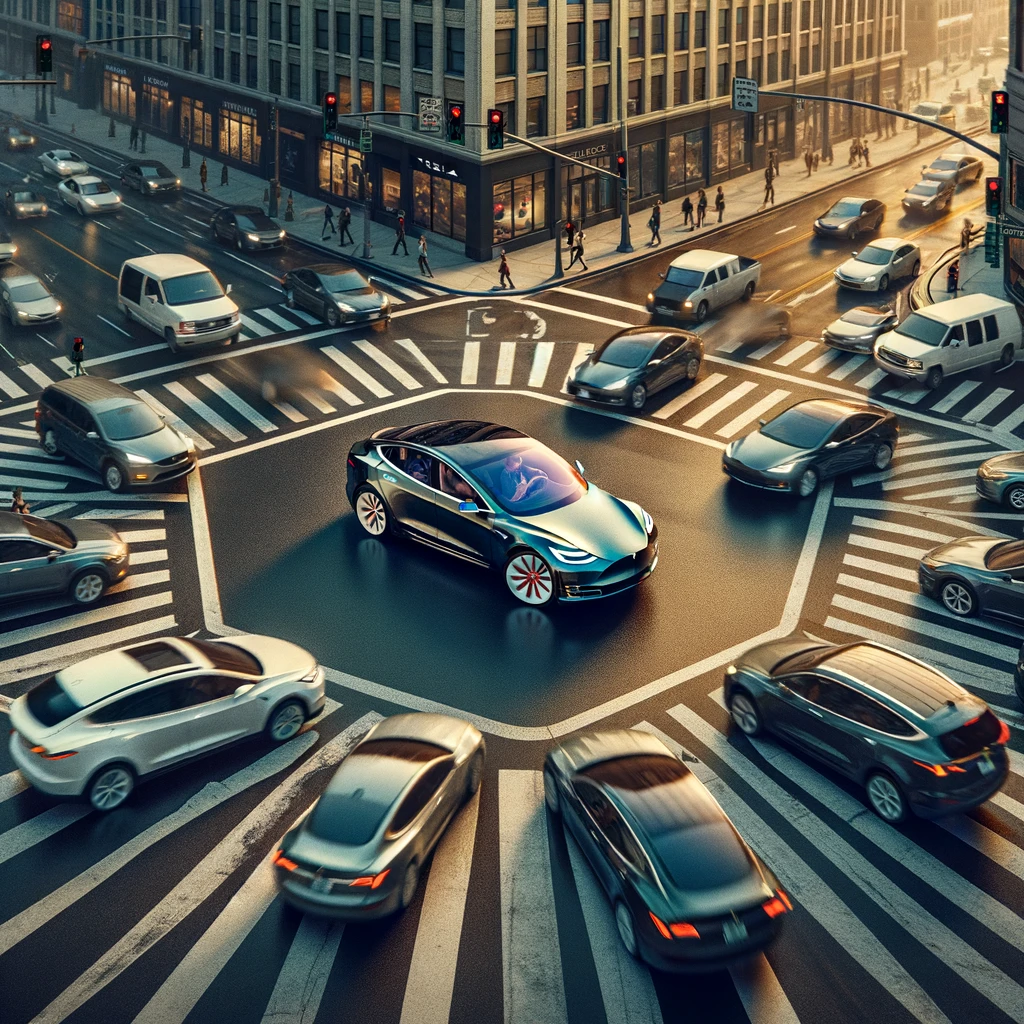
Last night I tried the new version of Tesla’s Full Self-Driving (FSD) and I must say, it is amazing. In a pair of 30-minute drives it did all the driving through congested suburbs, over backroads and on highways, and did a marvelous job without the need for any intervention on my part.
I have a 2019 Tesla Model S 100D. One of the wonderful things about Tesla is that unlike a normal car, where once you buy it you have the same car until you buy the new model, the Tesla automatically updates itself, adding new capabilities. These capabilities range from improved battery life, to more responsive windshield wipers. But most of the changes have come to automated driving.
When I first bought the car in 2019, I purchased the FSD package with the car. At the time, full self-driving was just a promise of future capabilities. A few months later, FSD was updated to basic functionality. It could drive the car competently on highways and back roads but was unable to stop at stop signs and traffic lights. Still, if you were driving on highways, it did an excellent job of driving with minimal supervision. It was quite good at merging in traffic and even taking off ramps.
A more recent update, in 2022, added the ability to stop at traffic lights and stop signs, but still did not handle turns at intersections. This was still very useful in rural areas or highway situations, but not as useful in more congested areas unless your route had no turns.
After that update, when people asked me if my Tesla could drive itself my standard response was “It’s good enough to be dangerous. It’ll do everything perfectly for dozens of miles and then suddenly try to do something disastrous, such as steering off the road.” The solid driving would lull you into a sense of security, making it easy to forget the potential risks. Eventually, I didn’t use it much because I had to be just as vigilant with its driving as with my own driving.
The latest update, which I installed last night, touts “Full Self-Driving (with supervision)” and it lives up to this claim. Using a new AI Neural Network it now handles all aspects of driving, not just highways. It now excels at city driving as well as country and highway driving.
In my two 30-minute tests, all I had to do was pull out of my parking space at the start of the journey and into a parking space at the end. The Tesla handled everything in-between, including highly congested areas, a stretch of highway, and meandering backroads. While the backroads were not congested, the route I took crossed several very busy roads.
The Good
Although I didn’t plan it, a number of odd things happened on the route, all of which the Tesla handled seamlessly: A truck unexpectedly pulled out in front of us on the highway, a mail carrier’s vehicle was parked at the side of the road, blocking half the lane, a pedestrian was crossing where they shouldn’t, there were cars pulled over to the side after a fender bender, and one lane of a backroad was closed for electrical work, with people guiding traffic down the single lane.
In each case, I was ready, in fact, probably overly ready to take over the driving but I didn’t because there was no need to. These cases, which I would be too nervous to even try with the previous version of FSD, were handled quickly and correctly by my Tesla. It even detected speed bumps and slowed down appropriately for them.
The Not Sure
I do suspect that there are regional differences in driving habits that might make driving a little difficult on AI. In eastern Pennsylvania, red lights are routinely ignored in the first few seconds after they turn red.
The place where this really matters is with left hand turns at intersections with traffic lights. In two instances, the left-turn signal turned off before it was clear for me to proceed. This meant that I had a yield; I could take a left turn if there was no oncoming traffic. These were extremely busy intersections, and I knew from experience that the light was short enough that it was highly unlikely there would be a break in traffic for me to turn left. In both cases I would have stopped at the white line marking the left lane stop and waited for the next light.
The Tesla did not. Instead, the Tesla entered into the intersection and waited for a break in traffic. As expected, not only was there no break, but one or two oncoming cars crossed the intersection after the light turned red. The net effect is that I was in the intersection long after the light was red and other traffic started coming. As soon as the traffic stopped coming the other way, the Tesla zoomed through. To be fair, this is a mistake I’ve made myself several times before I learned that at those intersections it’s best to just wait for the next left turn signal. I think the Tesla’s actions were reasonable, if not ideal.
In a third instance, I was taking a left at a light with no left turn arrow. There were two lanes coming the other way and the lane closest to me had a vehicle waiting to turn left. The other lane was free for a distance, but with a car coming behind. This led to a situation where I could go but was a bit at risk if the car in the non-turning lane sped up suddenly. The Tesla started going and I forced it to stop and wait for the non-turning car to go past.
Again, I think the Tesla’s actions were appropriate and we probably would have made it through the light safely by a clear margin, but I would have handled it differently.
The Really Amazing
In these two drives I faced multiple odd scenarios and merges. It went from on-ramp to highway and off-ramp to back roads without a hitch. The Tesla even correctly made a turn that I miss half the time I take this route. Overall, I feel as though the car drove better than I did.
One thing I really liked was that instead of being capped at the speed limit like the old FSD was (with some leeway to adjust speed a bit higher automatically), the new FSD will speed up to stay with traffic. At one point the rest of the traffic was going 80 so I was pleased that the Tesla was keeping up with traffic because a car going significantly slower than the rest of the traffic is a danger.
FSD also comes with settings so you can adjust how aggressive it will be. Most of the time I kept it on ‘calm’ where it stayed back from other cars and did not change lanes on the highway. I found this setting especially helpful on the highway where I didn’t want to be changing lanes a lot. The left turn situations I note above all occurred when it was set on ‘aggressive’ and it’s entirely possible that had it been set on ‘calm’ at the time, those situations would not have happened.
The press is all abuzz about Tesla changing the cost of FSD from $199 a month to $99 per month. This didn’t affect me because I bought the service for life when I bought the car.
They are missing the real story which is that Tesla has reached the point where their cars can truly be thought of as ‘self-driving’. It seems to me that this is a major achievement equivalent to the radio being invented or the first transcontinental railroad. Nothing will ever be the same from this point forward. It won’t be long before ‘learning to drive’ becomes a thing of the past. Car ownership is also likely to change when a fleet of always-available robotaxis ensures that cars are available whenever and wherever needed.
Tomorrow I will take a 10-hour trip in my Tesla. I fully expect that my contribution to the driving will be pulling out of the parking space on one end and into the parking space on the other. It is truly a new age.
Leave a Reply