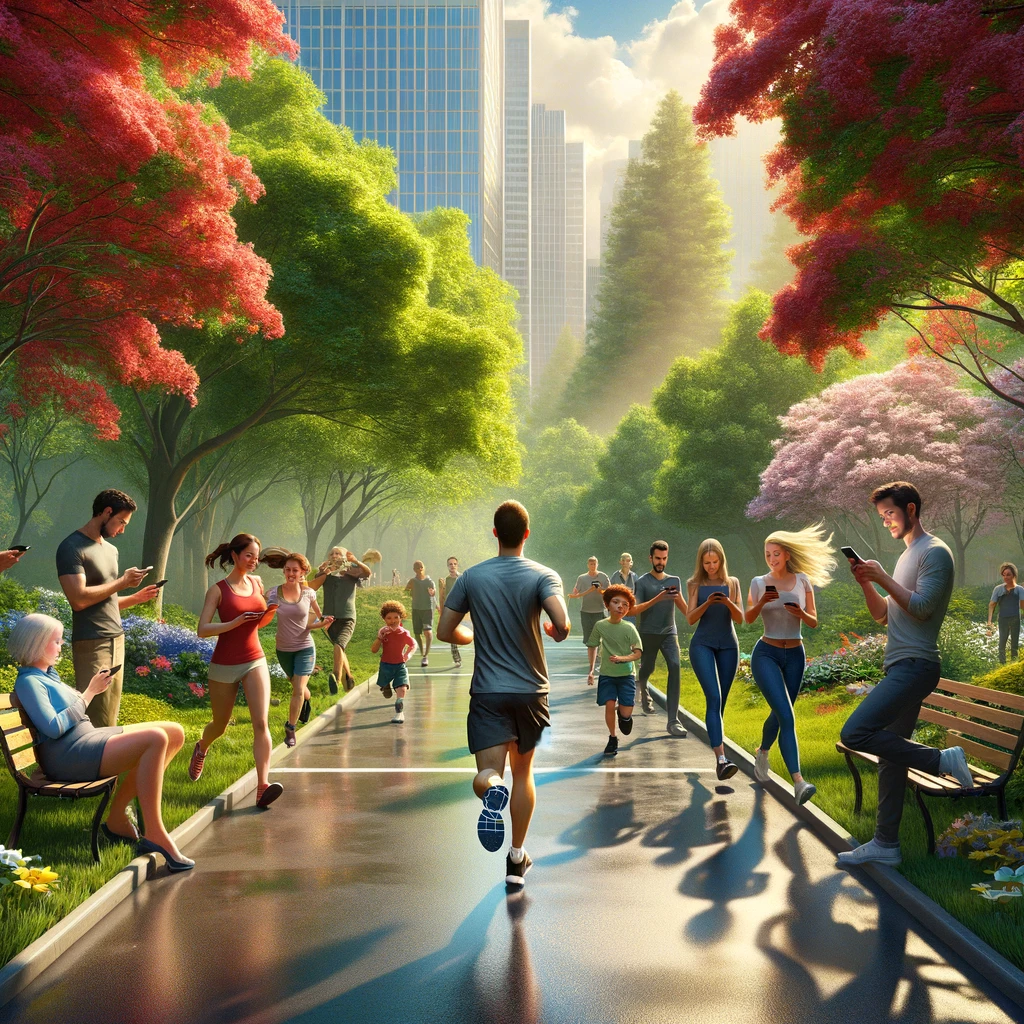
While taking my morning jog today, I passed by some kids walking to school. Everyone of them was looking down at their phone instead of at the lovely spring day. They weren’t even looking where they were going. This got me thinking that we already live in a virtual world. I don’t mean that ongoing argument about whether we live in a simulation, I mean that the internet is now the majority of our lives and attention. As a technologist, I think this is mostly a good thing; but that doesn’t mean we haven’t lost something.
I was checking my bank balance earlier and couldn’t help thinking how all of that money, the result of many years of hard work, is just a few ones and zeros in a computer somewhere. We aren’t rich and poor based on what possessions we have so much as on what some computer somewhere says we have. As someone who worked on banking software for years I can assure you that those ones and zeros are not as safe or free from bugs as you might expect.
I thought further about how my friends and business contacts primarily know me through the digital realm too. They’re more familiar with my online presence—my Facebook updates, emails, Instagram photos, TikTok videos, text messages, WhatsApp chats, and blog posts—than with me in person. Even my brother, with whom I communicate almost daily, does so through Discord voice chat. He lives down the street and I only see him a few times a year.
Recently when talking to someone over Microsoft Teams, they kept apologizing for their dog’s loud barking. Of course, I never heard the barking. Team’s excellent noise suppression effectively erased the dog from my hearing even though it was at the moment playing a big role in the life of the person I was speaking to. I felt sad that we were talking directly but living in very different worlds.
This realization made me think more deeply about the intricacies of our digital lives. Many of us carefully construct online personas that sometimes overshadow our real-world identities. Some, like me, stay largely away from posting (until this blog!) and feel a bit of an outsider because of it. Our joys, achievements, but almost never our failures, are broadcast across the digital ether. John Valery White, a law professor at UNLV and one of my favorite speakers, calls this the “Curated Individual.” This virtual existence isn’t just about presenting an idealized version of ourselves; it’s increasingly becoming the primary way we engage with the world.
The implications of this shift are profound. Relationships, once built on shared physical experiences and personal interactions, now often play out mostly on a digital stage. The art of conversation is evolving, with emojis and GIFs becoming as nuanced as body language once was. I was once chastised by a girlfriend for not including enough emojis! Even our sense of community is morphing, from physical neighborhoods to global online forums where interests and ideologies, rather than geography bind us together. Those groupings often being done automatically by algorithm and not choice.
Indeed, our very perception of reality is being shaped by algorithms designed to capture and retain our attention. The smartest minds of our generation have spent their genius figuring out how to get us to stare at our phones longer and click more often. News feeds are tailored to our preferences, creating echo chambers that reinforce our previously held views and beliefs, or worse, those of someone, or in the case of algorithms, something, looking to manipulate us. The danger here isn’t just in the polarization of society but in the distancing from a shared, objective reality. As our worlds become more personalized and insular, finding common ground becomes a challenge.
Despite that, I think this tech, is on the whole, beneficial to humanity and additive to our lives. This virtual world offers unparalleled opportunities for learning, connection, and growth. We have access to the sum of human knowledge at our fingertips, can maintain relationships across vast distances, and explore cultures and ideas that were once beyond our reach. You can create and run a multi-million dollar business just from your own home and art you create can reach potentially any person on earth. The key lies in balance, in leveraging these digital tools to enhance rather than replace the richness of real-world experiences.
As I reflect on these observations, I’m reminded that technology is merely a tool, and like any tool, its impact is shaped by how we use it. Perhaps it’s time to lift our eyes from our screens more often, to engage with the world directly, not just through the filter of digital interfaces. To notice that spring has sprung and the flowers are in bloom. To see real people in all their beauty and ugliness instead of the “Curated Individuals” on social media. Don’t get me wrong, I’ll be right back here typing on my keyboard tomorrow and talking to my brother on Discord. I wouldn’t have it any other way, virtual life is a rich one, but right now, I’m going to go for a walk and enjoy the nice spring day.
Don’t bother texting, I left my phone at home.
Leave a Reply