I was a terrible student as a teenager. I was bright, but my work ethic was non-existent. But, I had a foolproof way of passing. I would do the minimum possible and then the day before the big test I’d cram all night. This usually worked well enough that I got got As. This worked especially well for me in math and I was always in the top math classes.
It worked great until I got into calculus class. As my friend Danny likes to say, “it worked great until it didn’t”. This material was so much harder than what I’d dealt with before that a few hours work before the test just wasn’t going to cut it, I would have to start actually doing the homework and following the classes if I wanted to succeed.
I got lazy and I didn’t put in the work. My GPA and potential college choices suffered from my C- in the course. When I took the course again in college I did put in the work and earned an easy A+. Thank goodness I got a “do over”.
Business and AI
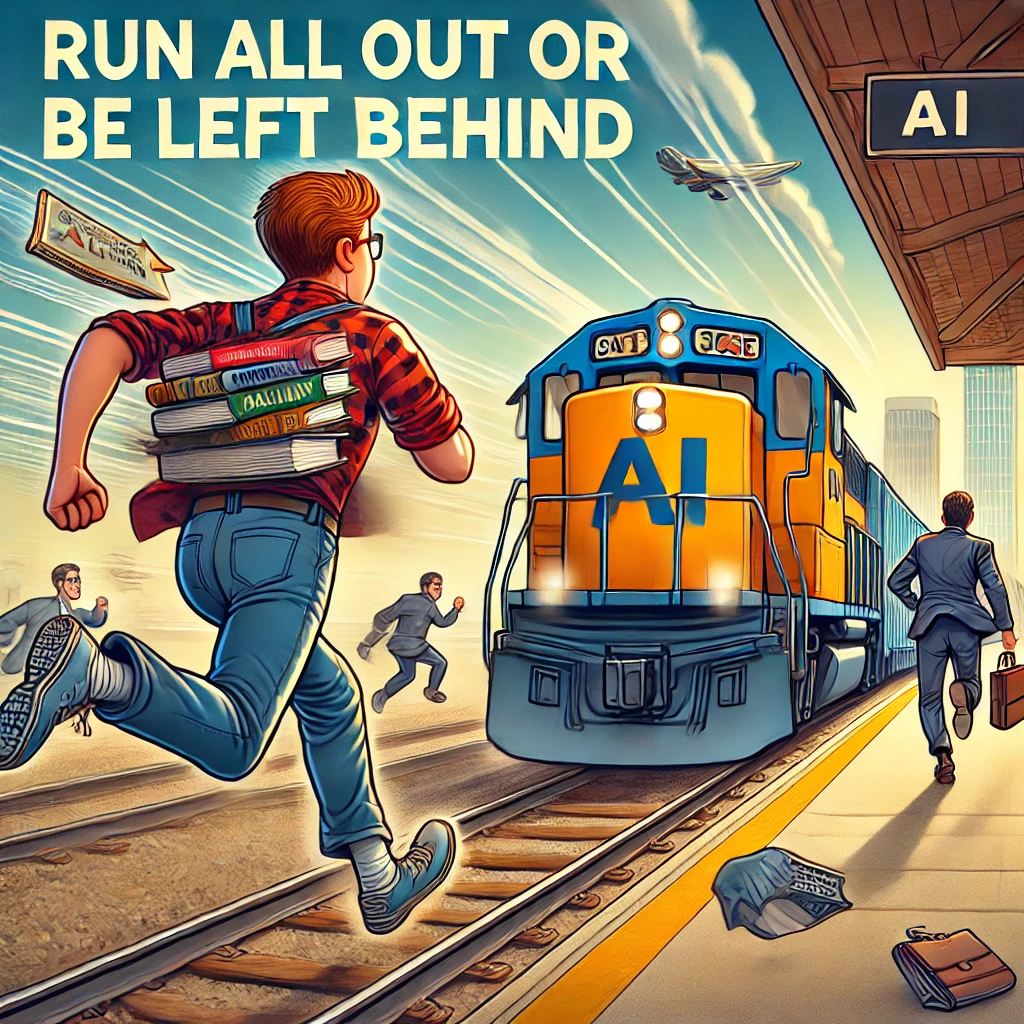
Businesses won’t get a do-over when it comes to AI. Those who don’t keep up with AI, even if the short-term return on investment is negative, will end up never being able to catch up. I have talked to many businesses, and the general feeling is “AI is moving so fast that we need to wait to see what’s next before we decide what to do”. This is like seeing your train leaving the station and deciding you should wait until it slows down to try to catch it. You’ll still be standing on the platform when everyone who ran for the train is in Chicago.
The disruption is bigger than you can imagine. For instance, one company I’m very familiar with has several lines of business, all of which likely will be decimated by AI in the next five years. One of their main businesses is in receiving, evaluating, and reassembling documents. Some of this is complex processing involving reading part of the document and putting that data into a database. While AI is not yet reliably able to do this, it is getting close and I’m highly confident that within eighteen months AI will do it faster, more accurately and at less than 10% of the current cost. They have resisted automation in the past and will almost certainly do so with AI.
But I doubt they’ll do anything about this oncoming change. If a particular outcome would result in decision-makers losing their positions, you can be certain they’ll find justifications for why that solution is infeasible. But an AI solution that does the job faster, less expensively and more accurately, will win out, likely offered by a competitor.
The dilemma
As I pointed out in a previous post this creates a huge dilemma. Given the rate AI is progressing, what is really difficult to do today may be trivial to do in a year. For instance, with the document handling I mentioned above in a year it may be possible simply to give the document to AI, tell it what to do and what the intended output is, and have it complete the job itself. No programming, no algorithms to figure out.
Given that, why put in the effort now?
The problem is we don’t know if this will be algebra or calculus. In other words, it may be that in a year AI is advanced enough and so simple to use that anyone can make it happen. It also could be that it’s advanced enough but takes immense expertise to use. In that case, only those who have “done the homework” will have a chance to pass the test. It could also be that by “doing the homework” they learn enough to implement this even before it’s trivial, thus keeping ahead of competitors. The worst-case scenario of working hard to try to make this happen is that you might end up with a lot of work you have to scrap and time that could have been spent on something else.
If you put in the effort and things advance enough that doing it becomes trivial you’ve wasted some time. If you don’t put in the effort and things advance so it can be done but takes a lot of expertise, which you haven’t developed, you’ve wasted your entire company.
Conclusion
If your company isn’t putting significant resources into AI, you are taking a big gamble with your future. The longer you wait the harder it will be to catch up. You can risk it all by waiting and watching, or you can run to catch the train while it’s still catchable.
My advice is to run full out to catch that train.

Leave a Reply